
Preparing for the FDA’s 12-Digit NDC Transition
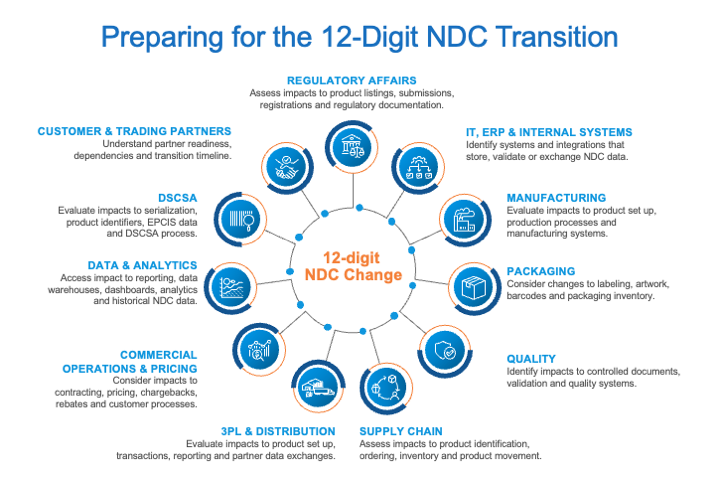
Prepare for the FDA’s 12-digit NDC transition with early planning for systems, partners, data governance, and March 2033 compliance readiness.
Preparing for the FDA’s 12-Digit NDC Transition: Why Manufacturers Should Start Early
The FDA’s final rule establishing a standardized 12-digit National Drug Code (NDC) format represents one of the most significant pharmaceutical master data changes in decades. With a compliance deadline of March 7, 2033, the transition introduces a new standardized format that will impact how NDCs are managed, stored, exchanged, and referenced throughout the healthcare ecosystem. For manufacturers, the transition should be viewed not as a labeling update or technical system change, but as an enterprise-wide initiative requiring cross-functional planning and stakeholder alignment.
For pharmaceutical manufacturers, the transition will require updates across systems, processes, and data repositories that rely on NDC data, including ERP platforms, serialization and traceability systems, labeling operations, regulatory submissions, pricing and contracting tools, and commercial data exchanges. In addition, manufacturers will need to coordinate closely with wholesalers, pharmacies, providers, reimbursement stakeholders, compendia publishers, and other trading partners to ensure alignment across the broader healthcare ecosystem.
Why is the FDA making this change?
The primary driver behind the rule is the FDA’s need to expand the capacity of the National Drug Code system. The current NDC structure provides a finite number of available code combinations, and growing demand for new labeler and product assignments has increased the need for a standardized format with greater long-term capacity.
Today’s NDC structure uses a variable-length format that requires the healthcare industry to convert the codes; this includes the commonly used 11-digit format. Over time, this has created unnecessary complexity, increased the potential for errors, and created system issues.
Under the new rule, all FDA-assigned NDCs will follow a consistent 6-4-2 format:
- 6-digit labeler code
- 4-digit product code
- 2-digit package code
This standardized structure provides additional capacity for new NDC assignments while simplifying how NDCs are managed, stored, and exchanged throughout the pharmaceutical supply chain. Existing NDCs will be represented within the new format through the addition of leading zeros where required, creating a uniform 12-digit structure across the industry.
More than just a labeling change
While product labeling will need to reflect the new format, the broader impact extends beyond packaging and artwork changes. Because NDCs are foundational identifiers across the pharmaceutical value chain, the transition has implications across supply chain, commercial, regulatory, and financial operations, including:
- Product serialization and DSCSA processes
- Manufacturing and packaging operations
- ERP and master data systems
- Regulatory submissions
- Distribution and 3PL integrations
- Wholesaler and customer EDI transactions
- Chargebacks, rebates and government pricing systems
- Commercial contracts that reference NDCs
- Customer portals and ordering platforms
- Forecasting, reporting and business intelligence tools
Many organizations have legacy systems that assume an NDC contains a fixed number of characters. Even seemingly minor elements such as database field lengths, validation rules, reporting logic, interfaces, and data integrations may require modification.
Preparing for the Transition: Ensuring Organizational Supply Chain Readiness
Although the compliance deadline remains several years away, large-scale master data transformations typically require extensive planning, stakeholder alignment, testing, and execution. Given the importance of NDCs across product, customer, pricing, contracting, regulatory, and reporting data platforms, manufacturers should evaluate not only system impacts, but also broader master data governance implications.
As manufacturers and distribution partners in the pharmaceutical supply chain begin to evaluate their readiness, there are several important factors to consider:
- Have all systems, processes, and data exchanges relying on the current NDC format been identified throughout the organization?
- Has the downstream impact been assessed across regulatory, IT, Supply Chain, Commercial Operations, Finance, Quality, and other functions?
- How will the transition affect interactions with external partners, including CDMOs, manufacturing partners, 3PL providers, distributors, pharmacies, government programs, and other trading partners?
- Are external vendors and technology partners preparing for the transition, and do their implementation timelines align with yours?
- Will internal systems and processes be able to support both legacy and new NDC formats during the transition?
- Have dependencies been identified that could create operational or financial risk if they are addressed too late?
The greatest challenge is unlikely to be the NDC conversion itself but rather identifying and managing downstream dependencies across the enterprise. Manufacturers that begin planning early will be better positioned to assess risk, align stakeholders, and develop a coordinated transition strategy that minimizes operational, financial, and compliance impacts.
Is your organization ready for the NDC transition? Connect with our team to evaluate readiness across systems, processes, and downstream partnerships. We can help identify potential gaps, assess risks, and develop a strategy that supports a smooth and successful transition.
For additional insights on this topic, you may also enjoy the following:



Mastering 3PL Economics for Manufacturers
Discover how specialized 3PL cost analysis helps manufacturers identify pricing discrepancies and negotiate with confidence.

Is Your Specialty Distribution Fee Schedule Keeping Pace?
Specialty distribution fee schedules must evolve with market conditions and service requirements. Archbow provides benchmarking, FMV analysis, and negotiation support to help manufacturers establish informed, defensible agreements.

Brand Planning Season is Here: Is Patient Access Strategy at the Table?
Build patient access into 2027 brand planning to reduce therapy delays, strengthen launch readiness, and drive sustainable pharmaceutical brand growth.
SUBSCRIBE
Subscribe to receive news and updates from Archbow Consulting
|
|